
Hiring a commercial construction project manager is not simply a matter of finding someone with “5+ years of experience” and a construction management degree.
The better question is: Can this person successfully manage the type of commercial project you are about to put in their hands?
A project manager overseeing a $5 million tenant improvement project may need a very different background from someone managing a $50 million ground-up development. The right hire needs to understand budgets, schedules, contracts, subcontractors, owners, architects, risk, documentation, and the realities of construction and know how to make decisions when those priorities collide.
If you’re looking to hire a commercial construction project manager, this article will help you evaluate candidates based on what actually matters: relevant project experience, technical capability, leadership, judgment, and evidence of results.
What Should You Look for When Hiring a Commercial Construction Project Manager?

A strong commercial construction project manager should demonstrate five things:
- Relevant commercial construction experience
- Proven control over budgets and schedules
- Strong subcontractor and stakeholder management
- Technical and construction-management knowledge
- The judgment and leadership to solve problems before they become expensive
The resume is only the starting point.
The strongest candidates can explain specific projects they have managed, the problems they encountered, the decisions they made, and what happened as a result.
That distinction matters.
A candidate who says they “managed project budgets” tells you very little.
A candidate who can explain how they identified a developing cost issue, worked with the superintendent and subcontractors to correct it, communicated the impact to ownership, and protected the project margin gives you something you can actually evaluate.
The U.S. Bureau of Labor Statistics describes construction managers as professionals who plan, coordinate, budget, and supervise construction projects, while coordinating with clients, architects, engineers, subcontractors, and other specialists.
For employers, that means hiring should focus on demonstrated performance-not just job titles.
Start With the Project, Not the Resume

Before reviewing candidates, define what your project actually requires.
This is one of the most overlooked steps when hiring a commercial construction project manager.
Consider:
- What type of project is it?
- What is the approximate project value?
- Is it ground-up construction, renovation, tenant improvement, or another delivery type?
- What is the schedule?
- How complex is the MEP scope?
- How many subcontractors will be involved?
- How much owner interaction will the PM have?
- Is the project design-build, design-bid-build, or another delivery model?
- Will the PM manage one project or multiple projects?
- What software and reporting systems does your company use?
The answers should determine your candidate profile.
A project manager who has successfully delivered small commercial renovations isn’t automatically the right person for a large ground-up healthcare, hospitality, office, or mixed-use development.
Match the candidate’s experience to the complexity of the project.
That is more useful than simply asking how many years they have worked in construction.
The Brightway Commercial Construction Project Manager Hiring Framework
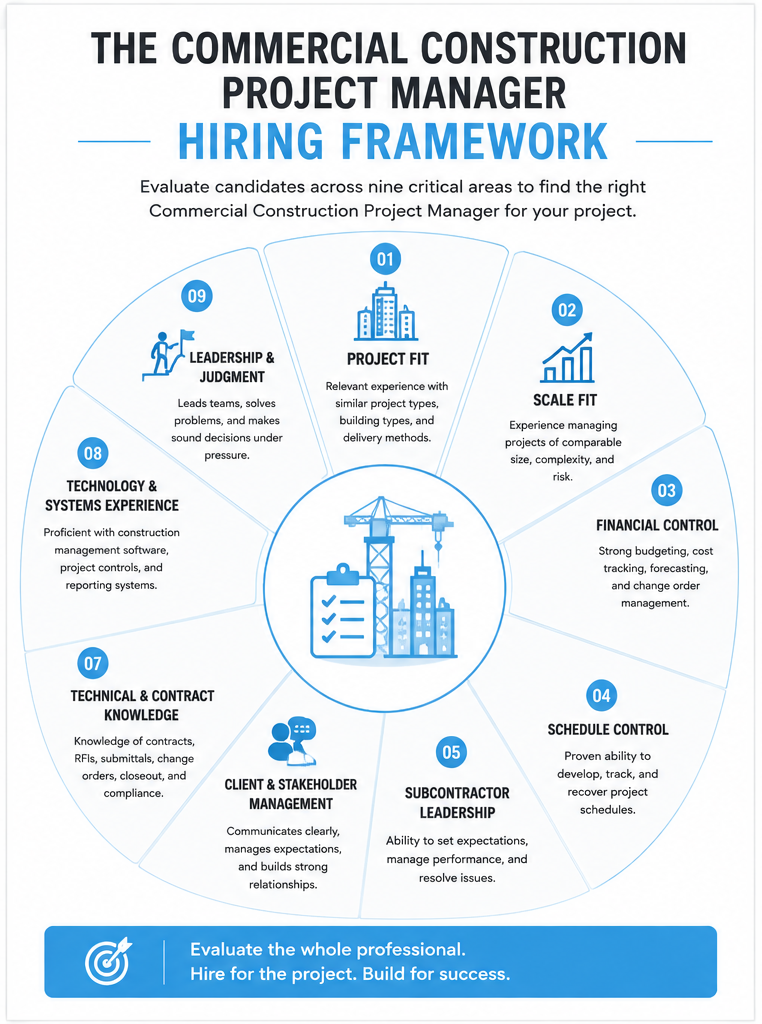
Once the project requirements are clear, evaluate candidates against the same framework.
This helps prevent a common hiring mistake: selecting the candidate with the most impressive resume rather than the candidate who is actually the best fit for the project.
1. Project Fit
Has the candidate managed projects similar to yours?
Look at:
- Project type
- Building type
- Delivery method
- Scope
- Construction phase responsibility
- Owner/client environment
Relevant experience could include:
- Office buildings
- Retail
- Hospitality
- Healthcare
- Education
- Multifamily
- Industrial facilities
- Mixed-use developments
- Tenant improvements
- Renovations
- Ground-up commercial construction
The closer the previous project environment is to your own, the less time the candidate may need to adapt.
But don’t automatically reject someone from a different commercial segment.
Instead, ask whether the candidate has successfully managed comparable complexity and risk.
2. Scale Fit
Project size matters, but it should not be treated as a simple numbers game.
A candidate who has managed a $15 million project may be highly capable of managing another $15 million project-but the real question is what responsibility they held.
Ask:
- What was the total contract value?
- What portion did you personally manage?
- How large was the project team?
- How many subcontractors were involved?
- What was the schedule?
- How much owner interaction did you have?
- What were the biggest risks?
Don’t confuse exposure with ownership.
A candidate who worked on a $100 million project isn’t necessarily a $100 million project manager.
You need to understand what they actually controlled.
3. Financial Control
A project manager can be an excellent communicator and still be a poor hire if they cannot control project financials.
Look for experience with:
- Budget development
- Cost tracking
- Forecasting
- Change orders
- Subcontractor costs
- Buyout
- Cost-to-complete forecasting
- Variance analysis
- Billing and payment processes
- Financial reporting
- Risk identification
But don’t stop at asking whether the candidate has “budget management experience.”
Ask for an example.
Interview question:
“Can you describe a project where you spotted a possible cost overrun early? What warning signs did you notice, and what steps did you take to address it?”
A strong answer should show more than awareness.
You want to hear how the candidate recognized the problem, evaluated options, communicated with stakeholders, and took action.
4. Schedule Control
Commercial construction schedules rarely survive without adjustments.
Material delays happen. Designs change. Inspections move. Subcontractors fall behind. Owners change requirements.
A good project manager doesn’t simply maintain a schedule.
They understand what threatens the schedule and what to do about it.
Look for experience with:
- Master scheduling
- Short-term and look-ahead schedules
- Critical-path awareness
- Procurement coordination
- Subcontractor scheduling
- Milestone tracking
- Schedule recovery
- Delay analysis
- Coordination between field and office teams
Ask:
“Walk me through a project that experienced a schedule setback. What led to the delay, and what actions did you take to get the project back on track?”
The answer can reveal far more than a resume bullet saying “managed project schedules.”
5. Subcontractor Leadership
A commercial construction PM often coordinates a large network of people who don’t report directly to them.
That requires more than organizational skills.
The candidate needs to know how to:
- Set expectations
- Hold subcontractors accountable
- Resolve disputes
- Track commitments
- Coordinate trades
- Escalate issues appropriately
- Maintain professional relationships
- Protect the project’s schedule and budget
Ask:
“Can you describe a situation where you faced challenges with a subcontractor? What was the issue, and how did you work toward a resolution?”
You’re looking for a candidate who can be firm without unnecessarily damaging the relationship.
The best project managers know when to collaborate, when to negotiate, and when to escalate.
6. Client and Stakeholder Management
Commercial construction projects can involve owners, developers, architects, engineers, consultants, inspectors, subcontractors, vendors, and internal leadership.
The project manager often becomes the person expected to make all of those parties understand what is happening.
Strong candidates should be able to communicate:
- Project status
- Schedule changes
- Budget concerns
- Change orders
- Risks
- Delays
- Quality issues
- Required decisions
Ask:
“Describe a situation where you needed to communicate difficult information to an owner or client. How did you approach the conversation?”
This is an excellent judgment question.
You don’t want someone who hides problems until they become unavoidable.
You want someone who identifies issues early, explains the impact clearly, and arrives with a plan.
7. Technical and Contract Knowledge
Commercial project managers operate in a documentation-heavy environment.
Candidates should understand the practical importance of:
- Contracts
- Scope clarification
- RFIs
- Submittals
- Change orders
- Purchase orders
- Pay applications
- Documentation
- Closeout
- Punch lists
- Warranty coordination
The goal isn’t to hire someone who knows every contractual clause by memory.
It’s to find someone who understands how documentation affects cost, schedule, accountability, and risk.
Ask:
“Tell me about a change order that had a meaningful impact on a project. How did you evaluate and manage it?”
8. Technology Experience
Technology proficiency should support the candidate’s construction-management ability, not replace it.
Depending on your company’s systems, relevant experience may include:
- Procore
- Autodesk Construction Cloud
- Bluebeam
- Primavera P6
- Microsoft Project
- Project scheduling platforms
- Estimating and cost-control systems
- Document-management systems
Don’t make software names the deciding factor.
Someone who has used Procore for several years but cannot explain how they control project risk is not necessarily a stronger hire than someone who has used another platform effectively.
Instead, ask:
“How have you used construction software to identify or prevent a project problem?”
That question tests whether technology is actually part of the candidate’s management process.
9. Leadership and Judgment
A project manager doesn’t become a strong leader simply because “Project Manager” appears on their resume.
Look for evidence of leadership.
Ask:
- How large was the team?
- Who reported directly to you?
- How did you handle an underperforming team member?
- How do you run project meetings?
- How do you keep field and office teams aligned?
- How do you handle conflict?
- How do you develop junior staff?
Then ask a question that tests judgment:
“Tell me about a commercial project that did not go as planned. What would you do differently today?”
A strong project manager doesn’t need a perfect project history.
They should be able to explain what went wrong, what they learned, and what they changed afterward.
What Experience Should a Commercial Construction Project Manager Have?

There is no universal number of years that guarantees a successful hire.
Experience should be measured against project complexity and responsibility.
Someone with seven years of experience managing projects comparable to yours may be a stronger candidate than someone with twelve years of experience working primarily on projects of a very different type or scale.
Look for evidence of experience with:
- Comparable project types
- Similar project values
- Similar delivery methods
- Budget ownership
- Schedule responsibility
- Subcontractor management
- Client communication
- Change orders
- Project closeout
- Construction documentation
- Risk management
Instead of asking:
“Does this candidate have enough years?”
Ask:
“Has this candidate successfully handled the problems they will face here?”
That’s a much better hiring standard.
What Should You Pay a Commercial Construction Project Manager?
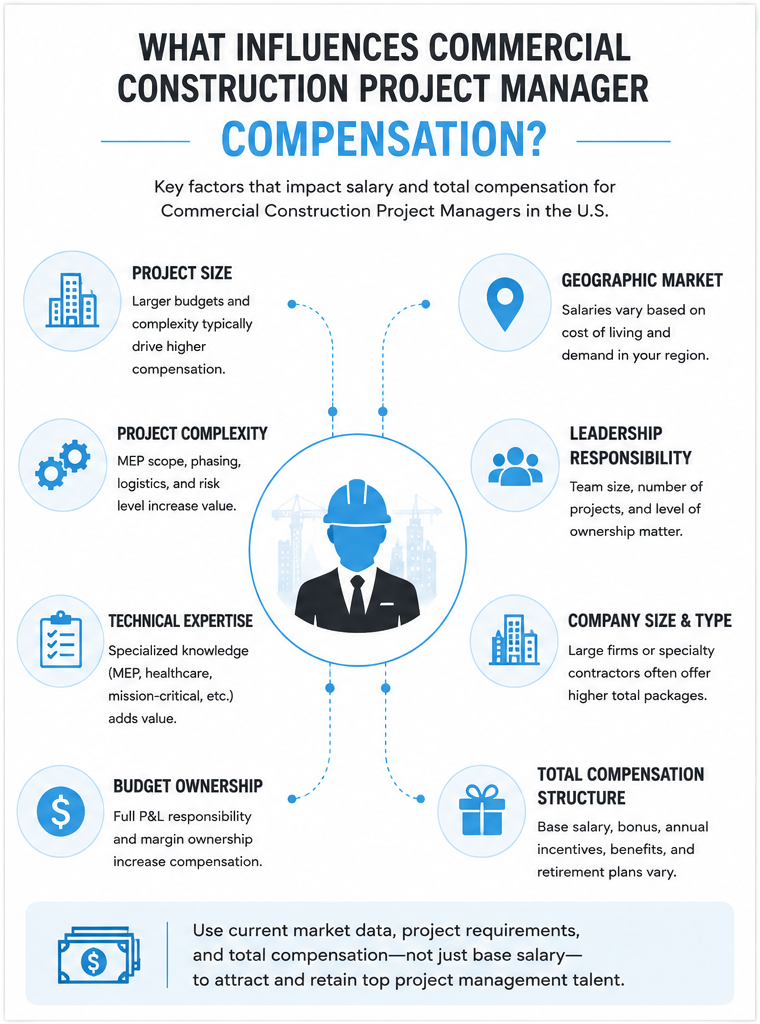
Compensation should depend on factors such as:
- Project size
- Geographic market
- Commercial construction experience
- Project complexity
- Leadership responsibility
- Technical expertise
- Budget ownership
- Client-facing responsibility
- Company size
- Overall compensation structure
Years of experience alone shouldn’t determine compensation.
A candidate who can independently manage a complex commercial project, protect margins, recover schedules, and maintain key client relationships may warrant a very different compensation package from someone whose experience has been narrower.
For employers, the better question is not simply:
“What is the average salary?”
It’s:
“What level of project responsibility are we asking this person to own, and what is the market value of someone who can successfully handle it?”
This approach also gives employers a better starting point for comparing candidates across different U.S. markets and experience levels.
10 Commercial Construction Project Manager Interview Questions
A structured interview makes it easier to compare candidates fairly.
1. Walk me through the most complex commercial construction project you’ve managed.
Listen for: project value, scope, team size, delivery method, actual responsibilities, and results.
2. Tell me about a project where you had to protect the budget under difficult circumstances.
Listen for: financial awareness, problem-solving, proactive management, and communication.
3. What is the biggest schedule problem you’ve faced, and how did you recover the project?
Listen for: ownership, planning, prioritization, and recovery strategy.
4. Tell me about a subcontractor who wasn’t meeting expectations. What did you do?
Listen for: accountability, communication, escalation judgment, and documentation.
5. Tell me about a time you disagreed with an owner, architect, or senior leader. How did you handle it?
Listen for: professionalism, negotiation, confidence, and judgment.
6. What is a construction risk you identified early that others had overlooked?
Listen for: experience, attention to detail, foresight, and technical understanding.
7. Tell me about a major change order you managed. What was your role?
Listen for: contract awareness, cost analysis, documentation, and stakeholder management.
8. How do you handle a team member who repeatedly misses commitments?
Listen for: leadership maturity, accountability, coaching, and decision-making.
9. Which construction-management systems have you used, and how did they improve your project management?
Listen for: practical experience, process understanding, and technology adoption.
10. Tell me about a commercial project that did not go as planned. What would you do differently today?
Listen for: accountability, self-awareness, lessons learned, and judgment.
Commercial Construction Project Manager Hiring Scorecard
Once interviews begin, don’t rely on memory or gut feeling.
Use the same scorecard for every qualified candidate.
| Evaluation Area | What to Assess |
| Project Fit | Experience with comparable commercial project types |
| Scale Fit | Similar project value, complexity, team size and schedule |
| Budget Management | Forecasting, cost control and financial accountability |
| Schedule Management | Planning, critical path and recovery experience |
| Subcontractor Management | Coordination, accountability and dispute resolution |
| Client Communication | Reporting, transparency and relationship management |
| Technical Knowledge | Construction processes, documentation and coordination |
| Contracts & Change Orders | Practical understanding of project controls |
| Technology | Relevant construction-management systems |
| Leadership | Team management, accountability and decision-making |
| Problem Solving | Evidence of handling real project challenges |
| Results | Completed projects and measurable outcomes |
How to use the scorecard
Don’t give every category the same weight.
For example, a complex ground-up commercial project may require heavier emphasis on:
Project Fit + Scale Fit + Budget Control + Schedule Control + Leadership
A smaller tenant-improvement project may place more emphasis on:
Client Management + Coordination + Scheduling + Documentation
The hiring criteria should reflect the actual job you’re trying to fill.
Red Flags When Hiring a Commercial Construction Project Manager
Not every red flag is an automatic rejection, but several should prompt deeper questions.
The resume lists responsibilities but no outcomes
“Managed projects, budgets, schedules and subcontractors” is easy to write.
Ask what actually happened.
The candidate can’t explain project numbers
If someone claims to have managed major projects but can’t clearly explain the project size, scope, team structure, or their responsibilities, investigate further.
Every problem was someone else’s fault
Construction is full of problems.
A candidate who has never made a mistake or never takes responsibility for one may be difficult to trust with a high-stakes project.
Strong technical knowledge but weak communication
A PM must translate technical problems into business decisions.
Strong communication but limited construction depth
Communication alone won’t protect a project from poor scheduling, weak cost control, or subcontractor issues.
Job titles don’t match actual responsibilities
Don’t assume a Senior Project Manager title means the person managed projects at the level you need.
Ask what they actually owned.
Reference Checks: Ask About Performance, Not Personality
References shouldn’t be a formality.
Instead of asking:
“Was this person a good employee?”
Ask:
- What size projects did they manage?
- How did they handle budget pressure?
- How did they respond when schedules slipped?
- How effectively did they manage subcontractors?
- How did they communicate difficult information?
- Would you trust them with another project of similar size?
- What type of environment brings out their best work?
- What would you coach them to improve?
That last question can be particularly valuable.
When Should You Use a Commercial Construction Recruiter?
Some commercial construction roles are difficult to fill because the strongest candidates aren’t necessarily applying to job postings.
Experienced project managers may already be employed, managing active projects, or selectively considering their next opportunity.
That creates a challenge for companies relying exclusively on inbound applications.
A specialized construction recruiter can help employers identify candidates based on:
- Project experience
- Construction sector
- Project size
- Geographic market
- Leadership level
- Technical skills
- Compensation expectations
- Career motivations
- Availability
The goal isn’t simply to produce more resumes.
It’s to find people whose experience actually matches the project and the organization.
For companies hiring across commercial construction, Brightway Career Consultants helps employers connect with construction professionals based on the requirements of the role and the needs of the business.
Explore Commercial Construction Recruitment or learn more about Construction Recruitment and Brightway’s broader construction recruiting capabilities.
Final Commercial Construction Project Manager Hiring Checklist
Before making an offer, make sure you can answer “yes” to these questions:
- Has the candidate managed projects similar to ours?
- Have they handled comparable budgets and schedules?
- Can they explain their role without relying on vague job-title language?
- Can they demonstrate effective subcontractor management?
- Have they managed change orders and project documentation?
- Can they identify and mitigate construction risks?
- Can they communicate difficult issues to owners and stakeholders?
- Can they explain a real example of recovering a troubled project?
- Have references confirmed the candidate’s claims?
- Does their leadership style fit our organization?
- Can they operate effectively within our project-delivery model?
If the answer is yes, you’re no longer hiring based primarily on a resume.
You’re hiring based on evidence.
The Best Commercial Construction Project Manager Isn’t Always the Most Experienced Candidate
When you hire a commercial construction project manager, it’s tempting to compare candidates by years of experience, job titles, certifications, or the size of the companies they’ve worked for.
Those details matter.
But they’re not enough.
The better hire is the person whose experience matches your project’s complexity, whose decisions hold up under pressure, and whose track record demonstrates that they can manage the financial, operational, technical, and human sides of construction.
If your company is struggling to find a commercial construction project manager with the right combination of experience and leadership, Brightway Career Consultants can help you approach the search more strategically.
Need help finding the right commercial construction project manager? Tell us about the role, project type, and experience you’re looking for.
